The short answer
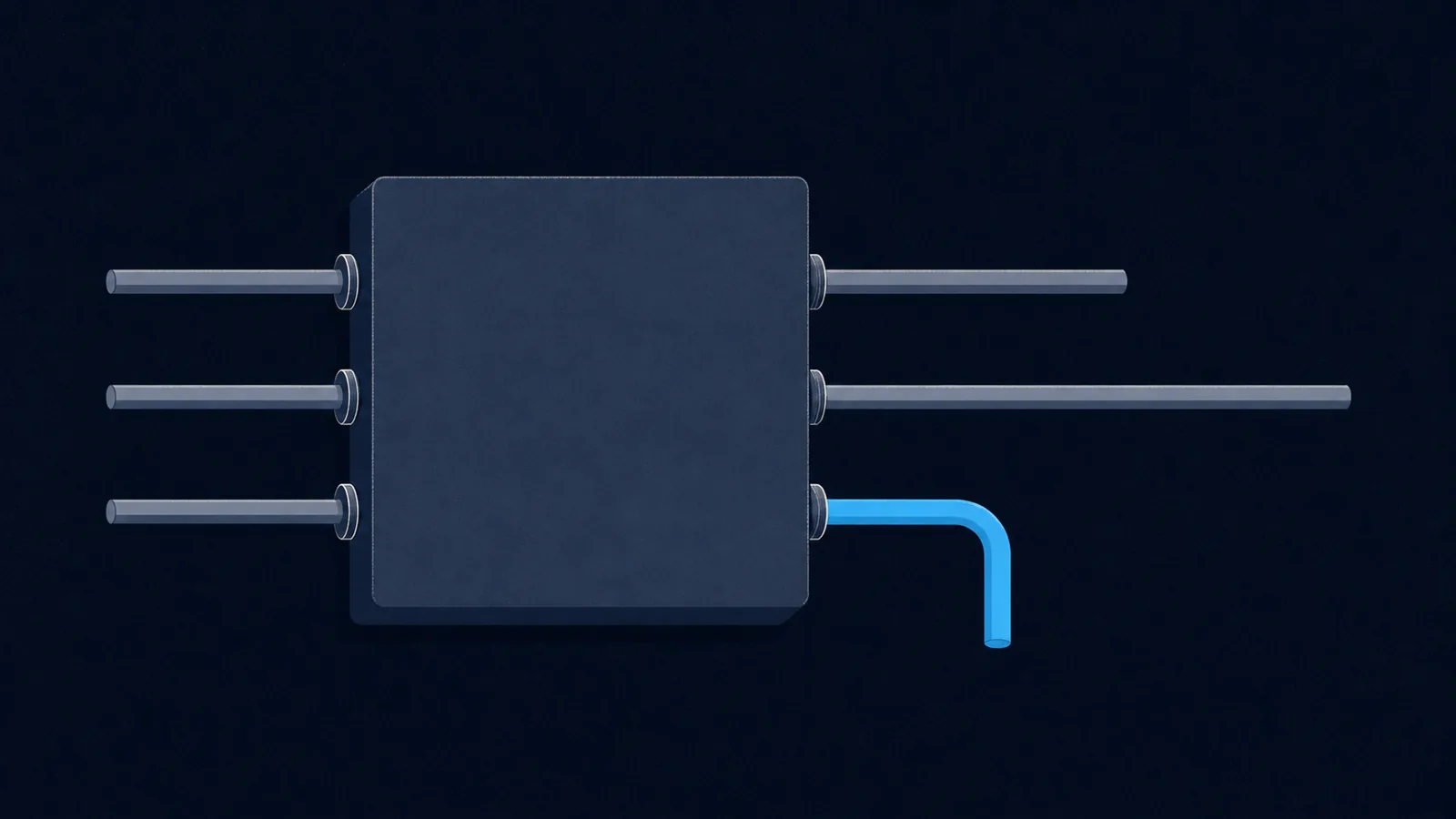
Don't try to identify a homebrew cipher by looking at its ciphertext. Feed it chosen plaintext and watch what moves. Flip one input byte and count how many output bytes change:
- One byte means a substitution you can solve with a 256-entry lookup table.
- Everything after that position means a chained or stateful cipher you unwind left to right.
- The whole block means a block cipher where the mode, not the math, is the weakness.
Three probes, about sixty seconds, and the attack picks itself.
How to read this
- 60-second skim: read the box above, then the decision workflow and quick reference tables at the bottom.
- 15-minute read: the whole guide, with the four cipher families and complete inversion code for each.
- 45-minute lab: run the probe script against any of the eighteen linked picoCTF challenges and classify it before reading the solution.
What counts as a custom cipher
A custom cipher is any encryption scheme the challenge author wrote themselves instead of calling a library. You'll recognize the genre immediately: a Python file named encrypt.py, forty lines of loops and modular arithmetic, and an output file full of numbers or base64. No AES, no RSA, just somebody's idea of scrambling.
These challenges frustrate people because the standard cryptography playbook doesn't apply. There's no published attack on a cipher that has existed for six weeks and has a total user base of one. Running a cipher identifier returns nothing useful, because identification tools match against known ciphers and this one is known to nobody.
Here's the reframe that makes them easy. Custom ciphers in CTF are almost never novel mathematics. They're short pipelines built from a handful of reversible primitives: add a constant, multiply mod something, XOR against a repeating key, permute the alphabet, chain each byte into the next. The author's creativity went into combining the primitives, not inventing one. So the job isn't cryptanalysis. The job is classification and inversion: figure out which primitives are in the pipeline, then run the pipeline backwards.
That distinction matters more than it sounds. Cryptanalysis is hard and open-ended. Inversion is mechanical. Every minute you spend trying to be clever about a homebrew cipher is a minute you could have spent asking it questions.
Related guides on this site
The three-probe test: what kind of cipher is this?
Most guides teach you to identify a cipher by staring at its output. That works for classical ciphers, where a Vigenere ciphertext has a recognizable index of coincidence and a rail fence has a recognizable shape. It fails on custom ciphers by construction, because the whole point is that nobody has seen this one before.
The chosen-plaintext probe works instead. If you have the encryption function, whether as a Python file you can import or a remote service you can send data to, you can ask it direct questions. Three of them settle the structure.
Probe 1: is it deterministic?
Encrypt the same plaintext twice. If the ciphertexts differ, there's a random nonce, an initialization vector, or a timestamp in the mix. That's not necessarily bad news: a weak nonce is often the intended vulnerability, and a nonce derived from the clock is usually brute-forceable over a few thousand candidate seconds.
Probe 2: does length change?
Encrypt inputs of length 1, 15, 16, 17, and 32. If ciphertext length tracks plaintext length exactly, you have a stream-like or substitution cipher and each output position corresponds to an input position. If output length jumps to the next multiple of 8 or 16, you have a block cipher with padding, and the block size just announced itself.
Probe 3: how far does one flipped byte travel?
Flipping one byte at a time is the probe that does the real work. Take a fixed baseline plaintext, flip exactly one byte, encrypt, and record which output positions changed. Repeat for every input position. The shape of the resulting diffusion map tells you the cipher family outright.
#!/usr/bin/env python3"""Classify an unknown cipher by chosen-plaintext probing."""def enc(data: bytes) -> bytes:# Replace this with the challenge's encryption call.# For a local encrypt.py: from encrypt import encrypt; return encrypt(data)# For a remote service: io.sendline(data.hex().encode()); return bytes.fromhex(io.recvline().strip().decode())raise NotImplementedErrordef probe(n: int = 32) -> None:base = bytes(n)# Probe 1: determinismprint('deterministic:', enc(base) == enc(base))# Probe 2: length behaviorfor size in (1, 15, 16, 17, 32):print(f'len(pt)={size:3d} -> len(ct)={len(enc(bytes(size))):3d}')# Probe 3: diffusion mapc0 = enc(base)for i in range(n):pt = bytearray(base)pt[i] ^= 0xFFc1 = enc(bytes(pt))changed = [j for j in range(min(len(c0), len(c1))) if c0[j] != c1[j]]print(f'flip byte {i:2d} -> {len(changed):3d} output bytes changed, first at {changed[0] if changed else None}')if __name__ == '__main__':probe()
Read the output of probe 3 against this table:
| Diffusion Pattern | Cipher Family | Attack |
|---|---|---|
| Flip byte i changes only byte i | Byte-independent substitution | Build a 256-entry lookup table |
| Flip byte i changes bytes i through the end | Chained or stateful stream | Unwind left to right |
| Flip byte i changes only its enclosing block of 8 or 16 | Block cipher in ECB-like mode | Attack the mode, not the round function |
| Flip any byte, every output byte changes | Full diffusion, or output is hashed | Look for a key or seed weakness instead |
| Flip byte i changes byte p(i) for some permutation p | Transposition layered on substitution | Recover p from the map, then invert both |
Byte-independent ciphers fall in one loop
If flipping input byte i only ever changes output byte i, then the cipher is a function of one byte at a time. It might be a Caesar shift, an affine map, an XOR with a constant, a scrambled alphabet, or something nobody has a name for. It does not matter. A function from one byte to one byte has exactly 256 possible inputs, so you can tabulate the entire thing.
# Build the full forward table, then invert it.forward = {i: enc(bytes([i]))[0] for i in range(256)}reverse = {v: k for k, v in forward.items()}if len(reverse) < len(forward):print('warning: not injective, some plaintexts collide')plain = bytes(reverse[b] for b in ciphertext)print(plain)
Two wrinkles show up often enough to plan for. The first: the map may depend on position as well as value, so byte i is transformed by a rule that includes iitself. The diffusion map still shows one-to-one locality, but a single table won't invert it. Build one table per position instead.
# Position-dependent substitution: one table per index.n = len(ciphertext)tables = []for pos in range(n):table = {}for byte in range(256):probe_pt = bytearray(n)probe_pt[pos] = bytetable[enc(bytes(probe_pt))[pos]] = bytetables.append(table)plain = bytes(tables[i][c] for i, c in enumerate(ciphertext))
That costs 256 * n encryption calls, which is instant locally and worth measuring first against a remote service. For a 50-byte flag it's 12,800 round trips, so batch them or find the pattern by hand.
The second wrinkle: the map may not be injective. If two plaintext bytes encrypt to the same ciphertext byte, information is genuinely gone and you'll need context to resolve the ambiguity. Flags are ASCII and follow a known format, so filter candidate decryptions by printability and the picoCTF{ prefix.
rotation and new-caesar both live in this family. So does reverse-cipher, where the transform is a short chain of per-byte operations that reads almost the same backwards as forwards.
Arithmetic and modular ciphers: invert the algebra
The most common homebrew scheme in CTF is some flavor of c = (a * p + b) mod m. Authors like it because it looks mathematical, and it is, but it's also the single most invertible thing in cryptography.
To reverse a multiplication modulo m, you need the modular inverse of a, which exists exactly when gcd(a, m) = 1. Python 3.8 and later give it to you directly with pow(a, -1, m), raising ValueError when no inverse exists.
When m = 256, which it usually is because the author is working on bytes, the coprimality condition has a memorable shape: 256 is 28, so the only prime dividing it is 2, and every odd multiplier is invertible. That is exactly 128 of the 256 possible values for a, so if a challenge multiplies bytes by an even constant it has thrown plaintext away and no inverse exists: you are looking for a different attack, or the author made a mistake. MITRE files exactly this class of homemade construction under CWE-1240.
# Affine cipher over bytes: c = (a * p + b) mod 256def affine_decrypt(ct: bytes, a: int, b: int, m: int = 256) -> bytes:a_inv = pow(a, -1, m) # raises ValueError if gcd(a, m) != 1return bytes(((a_inv * (c - b)) % m) for c in ct)# If a and b are unknown, brute-force them. There are only 128 valid# multipliers mod 256 (the odd ones) and 256 offsets.from math import gcdfor a in range(1, 256):if gcd(a, 256) != 1:continuefor b in range(256):guess = affine_decrypt(ciphertext, a, b)if b'picoCTF{' in guess:print(a, b, guess)
Watch the modulus. When authors work over the printable alphabet they often use mod 26 or mod 95 instead of mod 256, and the decryption silently produces garbage if you guess wrong. If the ciphertext bytes all sit inside a narrow range, that range is telling you the modulus.
A larger version of the same idea appears when the cipher chunks the plaintext into integers and does arithmetic on big numbers. Look for the chunk size, convert back with int.to_bytes, and check whether the operation is invertible over the integers before assuming you need anything cleverer.
# Plaintext chunked into big integers, then transformed.def chunks_to_bytes(values: list[int], size: int) -> bytes:out = b''for v in values:out += v.to_bytes(size, 'big')return out.lstrip(b'\x00')# Try both endiannesses and a few chunk sizes when the size isn't stated.for size in (2, 4, 8, 16):for order in ('big', 'little'):try:guess = b''.join(v.to_bytes(size, order) for v in values)except OverflowError:continueif b'pico' in guess:print(size, order, guess)
custom-encryption is the canonical example: a Diffie-Hellman-flavored key exchange wrapped around what turns out to be a simple multiply-and-XOR pipeline. The key exchange is theater. The cipher underneath inverts in four lines. c3 rewards the same skepticism: a "Custom Cyclical Cipher" whose provided encoder is short enough to invert directly.
Stateful ciphers: unwind them left to right
If flipping byte i corrupts everything from position i onward, each output depends on the outputs before it. The cipher carries state. The two common shapes are chained XOR and a keystream generator whose state advances per byte.
Chaining is the easier one. A scheme like c[i] = p[i] ^ c[i-1] ^ k looks tangled but unwinds in a single forward pass, because by the time you need c[i-1] you already have it: it's ciphertext, which you were given.
# Forward: c[i] = p[i] ^ c[i-1] ^ k (c[-1] = iv)# Inverse: p[i] = c[i] ^ c[i-1] ^ kdef unchain(ct: bytes, k: int, iv: int = 0) -> bytes:out = bytearray()prev = ivfor c in ct:out.append(c ^ prev ^ k)prev = creturn bytes(out)# k and iv are one byte each, so 65,536 combinations is nothing.for k in range(256):for iv in range(256):guess = unchain(ciphertext, k, iv)if guess.startswith(b'picoCTF{'):print(k, iv, guess)
Keystream generators need a different move. If the cipher is c[i] = p[i] ^ ks[i] for some generated keystream, and you can recover any plaintext you know, you get the keystream for free by XORing it back out. The flag format hands you eight known bytes before you start.
# Known-plaintext recovery of a keystream.known = b'picoCTF{'keystream_prefix = bytes(c ^ p for c, p in zip(ciphertext, known))print(keystream_prefix.hex())# If the generator repeats with period n, the whole thing unravels.def find_period(ks: bytes, max_period: int = 64) -> int | None:for n in range(1, max_period + 1):if all(ks[i] == ks[i % n] for i in range(len(ks))):return nreturn None
The most interesting stateful family is the linear feedback shift register, a keystream generator that produces the next bit as a fixed XOR of selected previous bits. LFSRs feel cryptographic and are catastrophically weak: because every output bit is a linear function of the initial state, seeing 2n output bits from an n-bit register is enough to solve for the whole thing.
# Berlekamp-Massey over GF(2): recover the shortest LFSR from a bit sequence.def berlekamp_massey(bits: list[int]) -> list[int]:n = len(bits)c = [1] + [0] * n # current connection polynomialb = [1] + [0] * n # last one that caused a length changelength, m = 0, -1for i in range(n):d = bits[i]for j in range(1, length + 1):d ^= c[j] & bits[i - j]if d:t = c[:]for j in range(n - (i - m)):c[j + i - m] ^= b[j]if 2 * length <= i:length, m, b = i + 1 - length, i, treturn c[1:length + 1] # the tap positions# Feed it the keystream bits you recovered from known plaintext.bits = [(byte >> (7 - k)) & 1 for byte in keystream_prefix for k in range(8)]taps = berlekamp_massey(bits)print('register length:', len(taps), 'taps:', taps)
Once you have the taps and any n consecutive output bits, you can run the register forward to generate as much keystream as the ciphertext needs, or run it backwards to recover the seed. shift-registers is exactly this attack. not-true also rewards treating the generator as a linear system rather than a black box. clouds is the instructive counter-example: it implements Nimbus, a real block cipher, and hands you a chosen-plaintext oracle, so the break is differential cryptanalysis rather than a linear solve. Confirm the generator is actually linear before you assume it.
When the encryption is really an encoding
A surprising share of custom cipher challenges aren't encryption at all. They're an encoding with unusual parameters: base64 with a shuffled alphabet, base-N with a handmade digit set, or a chain of standard encodings stacked deep enough to look scrambled.
The tell is the character set. Count distinct characters in the ciphertext. Sixteen means hex, thirty-two or thirty-six means a base-32 variant, sixty-four with padding means base64, eighty-five means ascii85. If the count matches a standard base but the characters are in the wrong order, you have a substituted alphabet and one known plaintext recovers the mapping.
from collections import Counteralphabet = sorted(set(ciphertext_text))print(len(alphabet), ''.join(alphabet))print(Counter(ciphertext_text).most_common(10))# Custom base64 alphabet: map the custom set onto the standard one.import base64STANDARD = 'ABCDEFGHIJKLMNOPQRSTUVWXYZabcdefghijklmnopqrstuvwxyz0123456789+/'CUSTOM = '...the challenge alphabet, in its own order...'table = str.maketrans(CUSTOM, STANDARD)print(base64.b64decode(ciphertext_text.translate(table)))
For stacked encodings, work outside in and let a chain tool do the bookkeeping. Recipe Chain applies decoding steps in sequence so you can peel layers without rewriting a script each time, and the ROT tool sweeps all 26 rotations at once when a layer turns out to be a plain shift.
multicode rewards checking for an encoding before assuming encryption: it is layered obfuscation with no key at all. hidden-cipher-1 is the other outcome of the same check. There really is a key, but the binary is UPX-packed, so unpacking it puts the XOR key in the data section next to the ciphertext.
Homemade block modes: attack the mode, not the cipher
When the diffusion map shows changes confined to a 16-byte window, the author built a block cipher, or more often wrapped a real one in a mode they invented. Do not attack the round function. Attack the mode.
The classic weakness is deterministic block reuse. If two plaintext blocks are identical and their ciphertext blocks are identical, the mode is ECB-shaped and leaks structure. You can detect this without knowing anything about the underlying cipher.
The 16-byte window is not arbitrary either. FIPS 197 fixes the AES block at 128 bits, so a diffusion map whose changes stop at a 16-byte boundary is telling you a real block cipher is underneath and only the mode is homemade. NIST SP 800-38A defines the five confidentiality modes (ECB, CBC, CFB, OFB, CTR) and states directly that ECB should not be used for messages longer than one block, because identical plaintext blocks produce identical ciphertext blocks. When your probe shows that property, you have found ECB regardless of what the author called it, and MITRE's CWE-327 is the name for it.
def repeated_blocks(ct: bytes, size: int = 16) -> int:blocks = [ct[i:i + size] for i in range(0, len(ct), size)]return len(blocks) - len(set(blocks))print('duplicate blocks:', repeated_blocks(ciphertext))# A byte-at-a-time ECB decryption oracle, when you control a prefix.# Align the unknown byte against a block boundary, then brute-force it.known = b''block = 16for i in range(block * 4):pad = b'A' * (block - 1 - (len(known) % block))target_block = (len(pad) + len(known)) // blockwant = enc(pad)[target_block * block:(target_block + 1) * block]for guess in range(256):probe_ct = enc(pad + known + bytes([guess]))if probe_ct[target_block * block:(target_block + 1) * block] == want:known += bytes([guess])breakelse:breakprint(known)
The other frequent weakness is a mode that chains blocks with a reversible combiner. If the author XORs each ciphertext block into the next, or adds blocks together mod 2^128, the chaining is invertible on its own and you can strip it without touching the block cipher at all. aes-abc is the textbook case: real AES, a homemade chaining mode, and the mode is additive, so the chain peels off with modular subtraction and the underlying blocks turn out to be recoverable.
black-cobra-pepper sits in the same territory, where the structure around the cipher is the vulnerability. play-nice is a different animal despite the family resemblance: no block mode at all, just Playfair on a 6x6 grid, with a fresh random key every connection, so the work is scripting the three decryption rules rather than inverting a chain.
Reading the source: a checklist that finds the weakness fast
Most of these challenges hand you encrypt.py. Reading it well is a skill of its own, and the trick is to read it in a deliberate order rather than top to bottom.
- Find where the flag enters. Search for the file read or the variable that holds plaintext. Everything before it is setup you can often ignore.
- Find every line that touches plaintext bytes. That short list is the actual cipher. Key exchanges, hashing of unrelated values, and elaborate class hierarchies frequently touch nothing.
- Check the key space. If the key is derived from
random.seed(int(time.time())), from a four-digit PIN, or from a short password, the cipher does not matter. Brute-force the seed. - Check each operation for invertibility. XOR and addition always invert. Multiplication inverts when it is coprime to the modulus. A hash, a truncation, or an
andwith a mask destroys information and tells you where the intended attack must live. - Check the loop bounds. Off-by-one errors that leave the first or last byte unencrypted are common, and one plaintext byte is often enough to unravel a chained scheme.
- Write the inverse function directly under the original. Line for line, in reverse order. Do not try to hold the inversion in your head.
guess-my-cheese-part-1 and ricochet both reward the key-space check before any cryptanalysis. college-rowing-team hinges on a seed you can enumerate.
The decision workflow
Put together, the whole approach is a short decision tree. Follow it in order and you will almost never waste time on the wrong attack.
| Step | Question | If Yes |
|---|---|---|
| 1 | Is the character set 16, 32, 64, or 85 symbols? | Treat it as an encoding, not a cipher |
| 2 | Is the key derived from a seed, PIN, or clock? | Brute-force the key space and stop |
| 3 | Does one flipped byte change exactly one output byte? | Build a 256-entry lookup table |
| 4 | Does it change everything after that position? | Unwind the chain, or recover the keystream |
| 5 | Does it change one 8 or 16 byte block? | Attack the mode: duplicate blocks, byte-at-a-time |
| 6 | Is the keystream a linear function of past bits? | Run Berlekamp-Massey and solve for the register |
| 7 | Is every operation individually invertible? | Write the inverse line by line in reverse |
Quick reference
Inversion cheatsheet
| Forward Operation | Inverse |
|---|---|
| c = p ^ k | p = c ^ k |
| c = (p + k) % m | p = (c - k) % m |
| c = (p * a) % m | p = (c * pow(a, -1, m)) % m |
| c = (p << n) | (p >> (8 - n)) | p = (c >> n) | (c << (8 - n)) |
| c[i] = p[i] ^ c[i-1] | p[i] = c[i] ^ c[i-1] |
| c = p[::-1] | p = c[::-1] |
| c = table[p] | p = {v: k for k, v in table.items()}[c] |
Tools on this site
Sanity checks before you give up
- Did you try both endiannesses when converting integers back to bytes?
- Is the modulus 256, or is it 26, 95, or 128 because the author worked in ASCII?
- Does the first or last byte behave differently from the rest?
- Is the key actually shorter than it looks, so the keystream repeats within the ciphertext?
- Did you check whether the ciphertext decodes as an encoding before assuming a key exists?
picoCTF custom cipher challenges
Every writeup below involves a hand-rolled cipher. Work them in roughly this order, since the earlier ones use one primitive and the later ones stack several.
Start here: single-primitive ciphers
Arithmetic and key-exchange wrappers
Stateful keystreams and registers
Block modes and layered constructions
Key-space and seed attacks
The first time I worked one of these I spent two hours trying to find a published attack on a cipher that existed only inside a 60-line file, which in hindsight is a bit like searching for a Wikipedia article about your neighbor. The cipher had no name because it had no history. Once you accept that, the work gets much simpler: stop asking what it is, and start asking what it does to a byte you control.
A homebrew cipher has no literature, no known attacks, and no name. It also has an author who had to make it reversible, which means you can reverse it too. Kerckhoffs made the point in "La cryptographie militaire" in 1883: a cipher must stay secure even when everything about it except the key is public. A homebrew scheme fails that test by construction, because its only defense was that you had not read it yet.
Sources and further reading
Homemade ciphers have no literature of their own, but the standards they imitate tell you what they got wrong.
- NIST SP 800-38A defines the five standard block-cipher modes and the ECB warning your diffusion probe is really testing for; FIPS 197 fixes the 128-bit AES block that shows up in the map.
- CWE-1240 (risky primitive implementation) and CWE-327 (broken or risky algorithm) are the two classifications almost every challenge cipher on this page falls under.
- Kerckhoffs (1883) for the principle that makes all of this work, and Python's three-argument
powfor the modular inverse you will need constantly.